A guest using a screen reader tries to book an accessible room on your hotel website in 2026. The date picker is unreadable, and the room listing says “accessible” without specifying whether it has a roll-in shower or grab bars. The guest gives up and turns to a competitor. This happens thousands of times a day across the industry.
An ADA-compliant hotel booking engine is an online reservation system that meets accessibility standards under the Americans with Disabilities Act, enabling travelers with disabilities to search, select, and book rooms independently. In practice, this means conforming to WCAG 2.1 AA guidelines across every step of the booking flow.

Most guides on this topic tell you hotel ADA compliance matters without showing you what to do about it. This one gives you the legal context, the revenue case, a technical checklist, and a vendor evaluation framework, all backed by current data you can act on today.
Why Hotels Cannot Ignore Booking Engine Accessibility
Most conversations about hotel booking engine accessibility start with lawsuits. But we’ll start this one with revenue.
According to the Open Doors Organization and MMGY Global, travelers with disabilities spend $58.2 billion annually on travel, taking 81 million trips. That is a market larger than the total annual revenue of most hotel chains. When your booking engine is not accessible, you are leaving a share of that market uncaptured.
An inaccessible booking engine creates four specific revenue leaks:
- Abandoned bookings. Guests who cannot complete the booking flow leave your site without converting.
- Increased front desk call volume. Guests who want to book but cannot do so online call your property instead, tying up staff and adding operational cost.
- Lost guests to competitors. Travelers who encounter barriers on your site will find a hotel that offers an accessible booking experience.
- A missed high-value market segment. The 81 million annual trips reported by the Open Doors Organization represent consistent demand that most hotels have not designed their direct booking experience to capture.
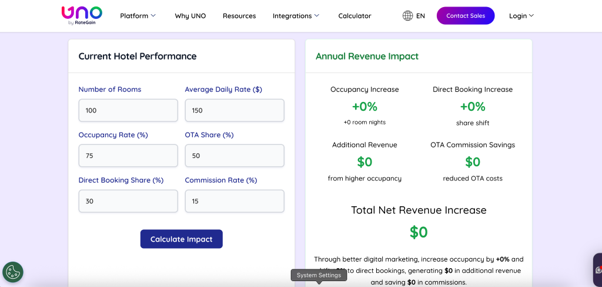
When your booking engine is accessible, travelers with disabilities can choose to book directly, expanding your channel mix and giving guests more options. You can calculate your direct booking potential to see what that means for your property.
ADA Compliance for Hotel Booking Engines
Hotels are classified as “places of public accommodation” under ADA Title III. This is not new. What has evolved is how courts interpret that obligation in the digital space.
Federal courts have consistently ruled that a hotel’s ADA obligations extend to its website and booking engine. The U.S. Department of Justice has reinforced this position, referencing WCAG 2.1 AA as the technical standard for accessible digital experiences. Your booking engine’s conformance to WCAG 2.1 AA is the benchmark courts will measure you against.
The enforcement numbers confirm the trend. According to Seyfarth Shaw LLP, 7,663 federal ADA Title III lawsuits were filed in 2023. Screen reader compatibility and keyboard navigation are among the most common digital accessibility complaint categories. These are documented patterns, not theoretical risks.
Compliance is a legal requirement, not a best practice. “We have not been sued yet” is not a strategy.
This guide provides an overview of ADA compliance considerations for hotel booking engines. It is not legal advice. Consult qualified legal counsel for guidance specific to your property.
ADA vs. WCAG 2.1 AA: What Standard Applies to Your Booking Engine?
This is the distinction most hotel decision-makers get wrong. ADA is the law. WCAG 2.1 AA is the technical standard that defines how to comply with it.
| ADA | WCAG 2.1 AA | |
|---|---|---|
| What it is | A federal civil rights law | A set of technical web accessibility guidelines |
| Who created it | U.S. Congress (1990) | World Wide Web Consortium (W3C) |
| What it requires | Equal access to public accommodations, including digital experiences | Specific, testable criteria for perceivable, operable, understandable, and robust web content |
| How it applies to hotels | Hotels must make their websites and booking engines accessible to guests with disabilities | The technical benchmark courts and the DOJ reference when evaluating digital ADA compliance |
| How it is enforced | Federal lawsuits, DOJ actions, and demand letters | Not enforced directly, but courts use it as the compliance standard |
| Current version | ADA as amended (2008), with 2010 Standards for Accessible Design | WCAG 2.1 (2018), maintained by the W3C |
Comparison of ADA and WCAG 2.1 AA as they apply to hotel booking engines.
If your booking engine conforms to WCAG 2.1 AA, you have established a strong foundation for ADA compliance. WCAG conformance alone does not guarantee legal immunity, but it demonstrates good faith and significantly reduces your risk.
Key takeaway: WCAG 2.1 AA is the standard your development team or booking engine vendor should be building against.
10 Technical Requirements for an ADA-Compliant Hotel Booking Engine
These are the specific WCAG 2.1 AA requirements that apply directly to your booking engine. Each one is testable, and each maps to a real feature your guests interact with during the booking flow. Hand this list to your vendor or IT team to assess where your booking engine stands today.
- Screen reader compatibility. Every element in your booking engine, from room types to rates to buttons, must use semantic HTML and ARIA labels so a screen reader can announce content like “King Room, Accessible, Roll-in Shower, $189 per night” instead of reading meaningless code.
- Full keyboard navigation. A guest must be able to complete the entire booking flow, from selecting dates to submitting payment, using only a keyboard with no mouse required at any step.
- Color contrast ratios. Text must meet a minimum 4.5:1 contrast ratio for normal text and 3:1 for large text per WCAG 2.1 AA, so light gray rate descriptions on a white background would fail this requirement.
- Accessible forms and error handling. All form fields must have visible labels, not just placeholder text, and error messages must be programmatically associated with the specific field so screen readers can announce what went wrong and where.
- Accessible date pickers and calendar widgets. Your date picker must be navigable with arrow keys and readable by screen readers. A visual-only calendar grid that requires mouse clicks to select check-in and check-out dates is non-compliant.
- Granular accessible room filtering. Guests need to filter by specific features like roll-in shower, grab bars, visual alarms, and TDD. A single “accessible” checkbox with no further detail is not sufficient.
- Descriptive alt-text for all images. Room photos must have meaningful descriptions like “King room with roll-in shower and grab bars, courtyard view,” not a filename like “room1.jpg” or a blank alt attribute.
- Responsive, mobile-first design. Touch targets must meet the WCAG minimum of 44×44 CSS pixels, and the entire booking flow must be fully functional on mobile screens without requiring pinching or horizontal scrolling.
- Focus management for dynamic content. When a guest selects a room and the rate display updates, keyboard focus must move to the updated content rather than staying on the previous element or jumping to the top of the page.
- Text resizing without loss of functionality. Your booking engine must remain fully usable when a guest increases text size to 200%, with no overlapping forms, hidden buttons, or clipped content.
What a Modern ADA-Compliant Booking Engine Looks Like in 2026
Now that you know the requirements, here is what a booking engine built for accessibility looks like at the architectural level. These are design decisions baked into the foundation.
- Semantic HTML foundation. Proper heading hierarchy, landmark regions, and form labels are coded from the ground up, giving screen readers the structure they need to navigate every page.
- Streamlined booking flow. Fewer steps mean fewer points where accessibility barriers can block a guest. A focused booking path, such as a 3-step flow from room selection through ancillary services to payment, reduces cognitive load for all users.
- Mobile-first responsive design. Layouts, font sizes, and touch targets are optimized for the smallest screen first, then scaled up. This approach naturally produces larger tap areas, cleaner layouts, and better readability across devices.
- Multi-language support with automatic browser detection. The booking engine identifies a guest’s browser language and serves content accordingly. For a global traveler base, this is both an accessibility feature and a conversion feature.
- Privacy and compliance by design. GDPR compliance, cookie consent management, and PCI-compliant payment processing are embedded in the architecture rather than patched in after launch.
Platforms like UNO Booking Engine reflect this architectural approach, with a 3-click checkout flow, 23 languages including native right-to-left Arabic with auto browser-language detection, mobile-first design, PCI-compliant payment processing, and a standard go-live of 3 days for a typical property with no development resources required. These architectural choices align with accessibility principles: a streamlined, mobile-first booking flow reduces barriers for all users, including those relying on assistive technologies.
How to Evaluate Your Booking Engine for ADA Compliance
Whether you are auditing your current system or evaluating a new vendor, these five questions will reveal how seriously a booking engine provider takes accessibility.
- “Can you provide documentation of WCAG 2.1 AA conformance?”
It’s a red flag if the vendor responds with “we follow best practices” but cannot produce a specific conformance report or audit summary.
- “Has the booking engine been audited by a third-party accessibility firm in the last 12 months?”
Red flag if no audit exists, or the most recent audit is older than a year. Accessibility is not a one-time checkbox.
- “Can the entire booking flow be completed using only a keyboard?”
Red flag if any step in the process, from date selection to payment submission, requires a mouse click. This is one of the most common complaint categories in ADA lawsuits.
- “How does the booking engine handle accessible room filtering beyond a generic checkbox?”
Red flag: the only option is a single “accessible” label with no way for guests to filter by roll-in shower, grab bars, visual alarms, or TDD.
- “What is your remediation timeline when an accessibility issue is found?”
It’s a Red flag if there is no defined SLA for accessibility fixes. Issues without a clear resolution path stay broken.
You can start a preliminary assessment on your own. Free tools like WAVE and Google Lighthouse will flag common issues in minutes. Keep in mind that automated tools catch roughly 30 to 40 percent of accessibility problems. Manual testing with a screen reader and keyboard-only navigation through the full booking flow is essential to uncover the rest.
Accessibility Is Now a Revenue Standard
An ADA-compliant booking engine reduces legal risk and creates a better booking experience for every guest. Accessible design improves usability, increases direct booking opportunities, and helps hotels compete for a growing travel audience that expects seamless digital experiences.
The right platform should combine WCAG-aligned architecture with strong conversion performance, mobile-first design, and fast deployment. UNO Booking Engine is built to reduce friction with a streamlined 3-click checkout flow, 23+ language support, privacy-first infrastructure, and a scalable direct booking experience.